A life history of unforgettable moments of clarity:
1983: Jesus
1994: Special relativity
2011: Analytic functions
I've known for a long time that I really should make use of analytic database functions. I think I've RTFMed a half-dozen times over the years, sometimes fumbling through an example or two, but never really getting them. Tom Kyte's appearance at the Dayton-Oracle User Group finally made it clear to me.
Fortunately, (a different delivery of) Tom's talk was recorded. Go, watch it! You don't have to live without analytic functions one more day!
In my case, I'd been tormented by questions about "the most recent record where..." in a MySQL database; the complex classic SQL queries I was using performed horribly in MySQL. MySQL doesn't have analytic functions, so I converted the reporting database to PostgreSQL. It paid off enormously; analytic functions cut several queries from multiple days to a few minutes. I am a Believer.
Wednesday, July 27, 2011

Thursday, July 14, 2011
KACE M300
We interrupt this blog with a message from my sponsor.
One of the cool things about working at KACE is helping make a product that people genuinely need and want. The job of keeping up with an organization's computers, networks, software, licenses, patches, security exposure, etc. is growing to near hopelessness for IT pros without good tools. KACE appliances are effective, affordable, and simple for medium and larger enterprises.
Small operations have different standards of what's "affordable" and "simple", though - so today KACE introduces the M300, a systems management appliance cheap and simple enough for virtually anybody.
I've only had a tiny, peripheral role in bringing out the M300, but it still feels really good. Better systems management is something the world truly needs - too many human souls pour way too many hours into the scutwork part of IT. I hope the M300 can get a lot more people get free from that.
One of the cool things about working at KACE is helping make a product that people genuinely need and want. The job of keeping up with an organization's computers, networks, software, licenses, patches, security exposure, etc. is growing to near hopelessness for IT pros without good tools. KACE appliances are effective, affordable, and simple for medium and larger enterprises.
Small operations have different standards of what's "affordable" and "simple", though - so today KACE introduces the M300, a systems management appliance cheap and simple enough for virtually anybody.
I've only had a tiny, peripheral role in bringing out the M300, but it still feels really good. Better systems management is something the world truly needs - too many human souls pour way too many hours into the scutwork part of IT. I hope the M300 can get a lot more people get free from that.
Wednesday, July 06, 2011
Tom Kyte in Dayton
Tom Kyte of asktom.oracle.com is coming to Dayton on July 14!
This is crazy-big for Dayton. Tom is one of the most amazing Oracle experts out there, with an immense knowledge of Oracle and a gift for getting straight to the heart of questions and problems; you really need to see him in action.
Thanks so much to Vicki Blommel for bringing this huge win to Dayton - when I was leading the Dayton Oracle User Group, I never even dreamed of bringing somebody this big to town.
This is crazy-big for Dayton. Tom is one of the most amazing Oracle experts out there, with an immense knowledge of Oracle and a gift for getting straight to the heart of questions and problems; you really need to see him in action.
Thanks so much to Vicki Blommel for bringing this huge win to Dayton - when I was leading the Dayton Oracle User Group, I never even dreamed of bringing somebody this big to town.
Monday, March 28, 2011
HTSQL and Indiana LinuxFest
Thanks and congratulations to Lord Drachenblut and the rest of the volunteer crew for putting on Indiana LinuxFest! They did a great job. I thought the participation was really impressive, looking and feeling more like a well-established conference than a brand-new one. Nothing will displace Ohio LinuxFest in my heart, naturally, but it looks like the community in this region can support and be bolstered by two annual conferences. It's almost enough to blunt the pain of missing PyCon... well, OK, not really. But it was still great. I got a chance to see Tarus Balog again, who's so gracious it's crazy, and meet a whole mess of FLOSS's other heroes... Thanks to all of them for making the trip to Indiana!
As a result of ILF, my determination to immerse myself in Puppet reached new heights. Earlier, I'd assumed it was only for people who administer servers by the dozens or hundreds, but now I see how much even my small server admin tasks need the sort of order and repeatability that Puppet can help give me.
I also got a chance to present on HTSQL, a new passion of mine since I first saw Clark Evan's submission for his PyCon talk. My slides are here (and, for once, they actually cover the bulk of what I said). However, you'll probably want to watch video from the PyCon talk by Clark Evans himself; he goes into much more detail than I did.
In a word, HTSQL is a gorgeously simple approach to database reporting. How gorgeous? Take a look at this dashboard. How simple? Go back to that dashboard and hit View Source. It's absurdly concise and comprehensible thanks to the HTRAF JavaScript library and HTSQL queries that fit comfortably and clearly into a URL, like this. Go spend some time playing with HTSQL if you care about data at all.
As a result of ILF, my determination to immerse myself in Puppet reached new heights. Earlier, I'd assumed it was only for people who administer servers by the dozens or hundreds, but now I see how much even my small server admin tasks need the sort of order and repeatability that Puppet can help give me.
I also got a chance to present on HTSQL, a new passion of mine since I first saw Clark Evan's submission for his PyCon talk. My slides are here (and, for once, they actually cover the bulk of what I said). However, you'll probably want to watch video from the PyCon talk by Clark Evans himself; he goes into much more detail than I did.
In a word, HTSQL is a gorgeously simple approach to database reporting. How gorgeous? Take a look at this dashboard. How simple? Go back to that dashboard and hit View Source. It's absurdly concise and comprehensible thanks to the HTRAF JavaScript library and HTSQL queries that fit comfortably and clearly into a URL, like this. Go spend some time playing with HTSQL if you care about data at all.
Tuesday, March 22, 2011
Indiana LinuxFest
First off, thanks to everybody who was at my Python intro at Millenicon. You can find the talk materials at http://catherinedevlin.pythoneers.com/ under "Talks".
Second, have you seen the great schedule at Indiana LinuxFest this weekend? They've really put together a lot of great material. (And I don't just say that because I'll be presenting on HTSQL.) I'm especially pleased that they have talks that will cater to my new love affair with Puppet. There's still time to sign up... hope to see you there!
Second, have you seen the great schedule at Indiana LinuxFest this weekend? They've really put together a lot of great material. (And I don't just say that because I'll be presenting on HTSQL.) I'm especially pleased that they have talks that will cater to my new love affair with Puppet. There's still time to sign up... hope to see you there!
Friday, March 18, 2011
Amateur Computer Programming
It's true: I missed PyCon 2011. Unbelievable. We have a sick horse who can't be left alone even for six hours, and our last-ditch scheme to get him to the OSU veterinary hospital, just before we were to leave for PyCon, foundered (ha!) with a broken-down truck and trailer on a small rural road. In the dark. And snow. Wasn't a good night. (Sigh) Next year, with feeling!
Anyway, onward. Tonight I'm on a panel at Millennicon (a straight-up SF con) titled "Amateur Computer Programming". I wanted to gather links to some short screencasts to give people an idea of some of the interesting tools out there.
Anyway, onward. Tonight I'm on a panel at Millennicon (a straight-up SF con) titled "Amateur Computer Programming". I wanted to gather links to some short screencasts to give people an idea of some of the interesting tools out there.
- resolverone.com lets you program spreadsheets
- sikuli.org drives your whole system by a script
- greasespot.net lets you reprogram somebody else's web app
- seleniumhq.org, a web testing framework
- renpy.org - easy visual novel authoring
- pygame.org - game writing
Monday, February 21, 2011
mysql rocks
No, I don't mean the MySQL server, about which my feelings are still very mixed. I'm still very keenly looking forward to moving to PostgreSQL. I mean mysql, the command-line client.
It's awesome! All those features that I've been gradually adding to sqlpython - at the cost of slow execution, and with my personal late-night bad quality control - most of them have been in mysql for years. Flexible output formats, easy interaction with the OS environment, and so forth. A fat toolbox of goodies.
So, how about this, Oracle? Oracle SQL*Plus has been neglected and underpowered for ages. It can't hold a candle to the mysql client for features. Why not assign a few programmers to extend the mysql client so that it works with Oracle as well as MySQL? Why should the world have to deal with a different client program for every database back-end? I can really imagine mysql evolving into the One True SQL Client.
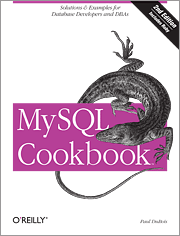
Finally, I have to praise the MySQL Cookbook from O'Reilly. For somebody moving to MySQL from another database, it's the only way to fly. Almost all MySQL books I've seen assume that it's your first database, and spend 90% of the text explaining SQL fundamentals. Based on my happy experience with the Python Cookbook, I thought the MySQL Cookbook would do better, and I was right. It cuts straight to the stuff that isn't obvious but is very, very useful.
(Hi. Yes, I've been quiet. Yes, I love the new job. Yes, it's a lot of work, particularly during this learning-the-ropes phase.)
It's awesome! All those features that I've been gradually adding to sqlpython - at the cost of slow execution, and with my personal late-night bad quality control - most of them have been in mysql for years. Flexible output formats, easy interaction with the OS environment, and so forth. A fat toolbox of goodies.
So, how about this, Oracle? Oracle SQL*Plus has been neglected and underpowered for ages. It can't hold a candle to the mysql client for features. Why not assign a few programmers to extend the mysql client so that it works with Oracle as well as MySQL? Why should the world have to deal with a different client program for every database back-end? I can really imagine mysql evolving into the One True SQL Client.
Finally, I have to praise the MySQL Cookbook from O'Reilly. For somebody moving to MySQL from another database, it's the only way to fly. Almost all MySQL books I've seen assume that it's your first database, and spend 90% of the text explaining SQL fundamentals. Based on my happy experience with the Python Cookbook, I thought the MySQL Cookbook would do better, and I was right. It cuts straight to the stuff that isn't obvious but is very, very useful.
(Hi. Yes, I've been quiet. Yes, I love the new job. Yes, it's a lot of work, particularly during this learning-the-ropes phase.)
Wednesday, November 10, 2010
Have you seen the elephant?
In case you're wondering, my upcoming work for KACE doesn't imply that I'm leaving Dayton. Like most of my coworkers, I'll work for KACE by telecommute. It's enormously flattering to be offered a position when the competitors for the job are potentially anybody on the surface of the earth. (Anybody who's interested in a Dayton jelly or telecommuters' club, let me know.)
That's good, but honestly, it's not the aspect of the new job I'm most excited about. It's this.

I'll migrate an important MySQL database to PostgreSQL and become its caretaker. I don't expect to use Oracle at all in the new job (though I'll stay active in the local Oracle community, and do some personal Oracle projects just for fun). Basically, I'll be a full-fledged PostgreSQL DBA.
Oracle has been practically a part of my identity for years, but those who have paid close attention have noticed me sighing in longing for PostgreSQL for years, too; I've said more than once that I'd drop everything to work full-time with PostgreSQL. I didn't think it would ever happen, since Dayton's main employer (the Air Force) has a strong prejudice for proprietary software. But, thanks to KACE, the impossible finally happened.
It's a funny coincidence - but yes, a coincidence - that this happens during a downswing in relations between Oracle and open-source communities; many F/OSS lovers are upset about Oracle's decisions since acquiring Sun. For me, though, it's not a matter of techie politics; PostgreSQL is simply a wonderfully-written database and a joy to work with.
As my relationship with PostgreSQL matures from a clandestine affair conducted at night to a full-time committed relationship, I'm sure we'll get past the honeymoon period and have some arguments, like any couple. Even the best software is still software, after all, and human-software relationships always have their difficult moments. Still, I'm enormously excited to begin this new phase in my love of free software.
Hmm. "PyOraGeek" might not be the most accurate subtitle anymore, but "PyPostgreSQL geek" violates uniqueness constraints in a big way. The rebranding is the hardest part...
That's good, but honestly, it's not the aspect of the new job I'm most excited about. It's this.
I'll migrate an important MySQL database to PostgreSQL and become its caretaker. I don't expect to use Oracle at all in the new job (though I'll stay active in the local Oracle community, and do some personal Oracle projects just for fun). Basically, I'll be a full-fledged PostgreSQL DBA.
Oracle has been practically a part of my identity for years, but those who have paid close attention have noticed me sighing in longing for PostgreSQL for years, too; I've said more than once that I'd drop everything to work full-time with PostgreSQL. I didn't think it would ever happen, since Dayton's main employer (the Air Force) has a strong prejudice for proprietary software. But, thanks to KACE, the impossible finally happened.
It's a funny coincidence - but yes, a coincidence - that this happens during a downswing in relations between Oracle and open-source communities; many F/OSS lovers are upset about Oracle's decisions since acquiring Sun. For me, though, it's not a matter of techie politics; PostgreSQL is simply a wonderfully-written database and a joy to work with.
As my relationship with PostgreSQL matures from a clandestine affair conducted at night to a full-time committed relationship, I'm sure we'll get past the honeymoon period and have some arguments, like any couple. Even the best software is still software, after all, and human-software relationships always have their difficult moments. Still, I'm enormously excited to begin this new phase in my love of free software.
Hmm. "PyOraGeek" might not be the most accurate subtitle anymore, but "PyPostgreSQL geek" violates uniqueness constraints in a big way. The rebranding is the hardest part...
sqlpython 1.7.2
sqlpython 1.7.2 has been released! Install it, pretend that your Oracle/PostgreSQL/MySQL database is a UNIX filesystem, and have a blast.
This release doesn't really add any new features. However, it does clean up the sluggishness in metadata operations (like ls and desc) and the major outright bugs that were making sqlpython frankly unusable for an embarrassing number of months.
Sorry for the wait! Hope you'll find the new sqlpython worth it. Functionality for PostgreSQL and MySQL are now fully-fledged, with some relatively minor exceptions (like image BLOB displays). Furthermore, my upcoming position guarantees that the sqlpython/PostgreSQL will get lots of love in coming months.
This release doesn't really add any new features. However, it does clean up the sluggishness in metadata operations (like ls and desc) and the major outright bugs that were making sqlpython frankly unusable for an embarrassing number of months.
Sorry for the wait! Hope you'll find the new sqlpython worth it. Functionality for PostgreSQL and MySQL are now fully-fledged, with some relatively minor exceptions (like image BLOB displays). Furthermore, my upcoming position guarantees that the sqlpython/PostgreSQL will get lots of love in coming months.
Monday, November 08, 2010
Moving to KACE
For almost ten years, I've worked for IntelliTech on contract at Wright-Patterson Air Force base. IntelliTech has been a very supportive employer, and my government boss at WPAFB (Ralph Ranard) has been an absolutely amazing supervisor; that's why I've been there so long.
This month, though, an opportunity has come up that I absolutely can't resist. I met Mike Gray and Tyler Gingrich of Dell KACE at Columbus Code Camp, which KACE sponsored partially to make contact with potential employees. (This, incidentally, shows excellent management right there. If you want skilled and passionate geeks, do you hire a recruiter to try to read the tea leaves of the self-promoting buzzwords of a huge stack of resumes? Or do you go to where the most passionate geeks congregate all on their own?)
Everything I've seen about KACE delights me so far. It's a subsidiary of Dell that has intentionally retained its startup spirit since its acquisition. Technical decisions are made by technical people for technical reasons - in other words, people are allowed to use the expertise they were hired for. (I know, that shouldn't be exceptional.) It's got a developer-centered culture that is a huge breath of fresh air. It's friendly to newer technologies and very friendly to open source. For example, I'll be taking over an important database currently in MySQL and migrating it to PostgreSQL. (Getting somebody to pay me for working with PostgreSQL has been a dream of mine for years...) And of course I'll be using Python. I'd wait tables before taking a job with no Python.
During my entire process of interviewing with KACE, it never felt like "job interviews" - those nerve-wracking, superficial, semi-adversarial dances described so depressingly in career publications. Rather, it felt like some long conference-hallway conversations between geeks - very real and very techie.
So... hello KACE! I'm delighted to join you!
This month, though, an opportunity has come up that I absolutely can't resist. I met Mike Gray and Tyler Gingrich of Dell KACE at Columbus Code Camp, which KACE sponsored partially to make contact with potential employees. (This, incidentally, shows excellent management right there. If you want skilled and passionate geeks, do you hire a recruiter to try to read the tea leaves of the self-promoting buzzwords of a huge stack of resumes? Or do you go to where the most passionate geeks congregate all on their own?)
Everything I've seen about KACE delights me so far. It's a subsidiary of Dell that has intentionally retained its startup spirit since its acquisition. Technical decisions are made by technical people for technical reasons - in other words, people are allowed to use the expertise they were hired for. (I know, that shouldn't be exceptional.) It's got a developer-centered culture that is a huge breath of fresh air. It's friendly to newer technologies and very friendly to open source. For example, I'll be taking over an important database currently in MySQL and migrating it to PostgreSQL. (Getting somebody to pay me for working with PostgreSQL has been a dream of mine for years...) And of course I'll be using Python. I'd wait tables before taking a job with no Python.
During my entire process of interviewing with KACE, it never felt like "job interviews" - those nerve-wracking, superficial, semi-adversarial dances described so depressingly in career publications. Rather, it felt like some long conference-hallway conversations between geeks - very real and very techie.
So... hello KACE! I'm delighted to join you!
Monday, October 18, 2010
Camping in Ohio
This Saturday was the Columbus Code Camp, and I have to say I was really impressed. The quality of the talks - and the audiences - was excellent, and it was a nice broad set of interesting topics. Mike Reed and the other organizers should feel great about putting together such a good event, especially for its maiden voyage. I look forward to it as a regular event.
My talk slides and materials are the same as the Ohio LinuxFest versions. Thanks to my audience for the great questions!
Next weekend comes the Southwest Ohio GiveCamp, a big hackfest to rapidly produce software for area nonprofits. I've never been to a GiveCamp before, and I'm really looking forward to it; I've heard great things from people who have participated before. Python folks, step forward - I want to make sure there are enough of us to form at least one strong team writing Python-based software.
Scheduling of tech events is an interesting topic. If it's held on a weekend, you know you're getting genuinely passionate professionals, people who want to spend their own time learning new things and improving their skills. If it's held on a weekday, you know you're getting people who work for smart companies that value their employees' skill and know that user-driven events are a great (and cheap) form of training... as well as a few attendees who are so hard-core that they'll actually take their own vacation time for learning. Either way, it reveals a lot about which people and employers are really dedicated to being and staying sharp.
My talk slides and materials are the same as the Ohio LinuxFest versions. Thanks to my audience for the great questions!
Next weekend comes the Southwest Ohio GiveCamp, a big hackfest to rapidly produce software for area nonprofits. I've never been to a GiveCamp before, and I'm really looking forward to it; I've heard great things from people who have participated before. Python folks, step forward - I want to make sure there are enough of us to form at least one strong team writing Python-based software.
Scheduling of tech events is an interesting topic. If it's held on a weekend, you know you're getting genuinely passionate professionals, people who want to spend their own time learning new things and improving their skills. If it's held on a weekday, you know you're getting people who work for smart companies that value their employees' skill and know that user-driven events are a great (and cheap) form of training... as well as a few attendees who are so hard-core that they'll actually take their own vacation time for learning. Either way, it reveals a lot about which people and employers are really dedicated to being and staying sharp.
Monday, September 13, 2010
pdb with Sikuli
As I mentioned in my last post, the big barrier to debugging a Sikuli script with pdb is that, when you enter a debugging command like "next", "continue", etc. that is supposed to allow program flow to continue, you are in the debugging console window, and your Sikuli script will send the keyclicks and mouse actions into the debugging console window instead of the application your script was supposed to be driving.
Here's a minor modification to pdb that can change that by using Alt-TAB to switch back to the application window every time program flow moves from the debugger to the application. Save this code as sikpdb.py in the Lib directory that you unzipped Sikuli into, for example, ~/Sikuli-IDE/Lib. (/Lib is not created by default, but it is the first item in sys.path.)
Now, at the point in your Sikuli script where you want to enter the debugger, insert
Also remember that you need to add -Dsikuli.console=false to your .sh or .bat script in order to allow pdb input/output to appear in the console window you used to invoke Sikuli. Otherwise, Sikuli will just hang when you attempt to enter the debugger (it's waiting for your input - in some nonexistant interactive session). For instance:
The remaining problem is that sikpdb.py depends on the notion that ALT-TAB will reliably return you to the application's window. This is true, but only if you do not browse around among your open windows while in the debugger; if you do, you'll change the z-ordering of the windows. It would be more reliable to call switchApp() with the title of the application's window, but I don't know of a cross-platform way to automatically detect it - the best I can think of would be to manually pass it as an argument to set_trace, have set_trace store it in an instance variable like self._application_window_title, then call
Here's a minor modification to pdb that can change that by using Alt-TAB to switch back to the application window every time program flow moves from the debugger to the application. Save this code as sikpdb.py in the Lib directory that you unzipped Sikuli into, for example, ~/Sikuli-IDE/Lib. (/Lib is not created by default, but it is the first item in sys.path.)
#! /usr/bin/env python

"""A Python debugger.

   A slight modification of ``pdb``; attempts to switch
   screen focus back to the invoking app before running commands
   in the program being debugged.  This should prevent Sikuli
   commands from being "typed" or "clicked" into the debugger
   window when they should go into the window of the app being
   debugged."""
# catherinedevlin.blogspot.com
# (See pdb.doc for documentation.)

import pdb
import sys

class Pdb(pdb.Pdb):
    def _to_running_window(self):
        """Moves focus to the window a Sikuli script was running
           before the debugger was invoked, so that subsequent commands
           will act in the app instead of the debugger."""
        self.onecmd("SCREEN.type(Key.TAB, KEY_ALT)")

    def do_step(self, arg):
        self._to_running_window()
        return pdb.Pdb.do_step(self, arg)
    do_s = do_step

    def do_next(self, arg):
        self._to_running_window()
        return pdb.Pdb.do_next(self, arg)
    do_n = do_next

    def do_return(self, arg):
        self._to_running_window()
        return pdb.Pdb.do_return(self, arg)
    do_r = do_return

    def do_continue(self, arg):
        self._to_running_window()
        return pdb.Pdb.do_continue(self, arg)
    do_c = do_cont = do_continue

def set_trace():
    Pdb().set_trace(sys._getframe().f_back)
Now, at the point in your Sikuli script where you want to enter the debugger, insert
import sikpdb; sikpdb.set_trace()Also remember that you need to add -Dsikuli.console=false to your .sh or .bat script in order to allow pdb input/output to appear in the console window you used to invoke Sikuli. Otherwise, Sikuli will just hang when you attempt to enter the debugger (it's waiting for your input - in some nonexistant interactive session). For instance:
$ cat sikuli-ide.sh
#!/bin/sh
DIR=`dirname $0`
java -Xms64M -Dsikuli.console=false -Xmx512M -Dfile.encoding=UTF-8 -jar $DIR/sikuli-ide.jar $*
The remaining problem is that sikpdb.py depends on the notion that ALT-TAB will reliably return you to the application's window. This is true, but only if you do not browse around among your open windows while in the debugger; if you do, you'll change the z-ordering of the windows. It would be more reliable to call switchApp() with the title of the application's window, but I don't know of a cross-platform way to automatically detect it - the best I can think of would be to manually pass it as an argument to set_trace, have set_trace store it in an instance variable like self._application_window_title, then call
self.onecmd("switchApp('%s')" % self._application_window_title) in place of self.onecmd("SCREEN.type(Key.TAB, KEY_ALT)") . It's more complex to use, but more reliable... feel free to use that approach if you prefer it.
Sunday, September 12, 2010
Sikuli talk follow-up
Thanks to everybody who made time in a busy Ohio LinuxFest schedule to make it to my talk on Project Sikuli! I appreciated your attention and your questions.
You can browse my slides at http://catherinedevlin.pythoneers.com/presentations/sikuli/sikuli.html, and/or download a tarball with all the code demonstrated at http://catherinedevlin.pythoneers.com/presentations/sikuli.tar.gz
I promised to follow up on the questions that stumped me, so here are the first couple answers...
- I mentioned how debugging with pdb is difficult because switching to the command-line window to interact with pdb interrupts the program flow, and when you issue a "continue" in the debugger, your Sikuli script will barrel along in the command-line window with the debugger instead of in the application you wanted Sikuli to drive. A couple people suggested debugging the script from a remote machine, connecting with pdb and attaching the debug process to the Sikuli process. I still don't know whether that's possible - definitely maybe - but I realized that there's a very simple remedy that I feel silly for not suggesting before.
In your Sikuli script at the point you want to enter the interactive debugger, instead of simply inserting
EDIT: WAIT - I got this wrong - this doesn't make sense. You do need to switchApp() back to the window your script was running in, but not immediately after invoking pdb.set_trace(); rather, it needs to be invoked just before running pdb.next, pdb.continue, etc. I think the right way to do this is to subclass pdb; give me a bit to produce and test something like that.
- I confirmed that there isn't yet a "Recording" mode, or anything to automatically translate your actions into Sikuli commands. Really, though, I'm not sure how much that would help - writing the Sikuli commands is actually the easy part of the automation. The hard part is figuring out precisely which actions to take to get the effects you want most reliably.
OLF was really good this year. I especially enjoyed the hallway track - met lots of really interesting people that I need to follow through with on some neat ideas. The exhibit hall was a great place for PyOhio folks to meet new people and connect them with the Python community - thanks so much for all the PyOhio crew who came out to staff the booth! Thanks to the organizers for all their work!
You can browse my slides at http://catherinedevlin.pythoneers.com/presentations/sikuli/sikuli.html, and/or download a tarball with all the code demonstrated at http://catherinedevlin.pythoneers.com/presentations/sikuli.tar.gz
I promised to follow up on the questions that stumped me, so here are the first couple answers...
- I mentioned how debugging with pdb is difficult because switching to the command-line window to interact with pdb interrupts the program flow, and when you issue a "continue" in the debugger, your Sikuli script will barrel along in the command-line window with the debugger instead of in the application you wanted Sikuli to drive. A couple people suggested debugging the script from a remote machine, connecting with pdb and attaching the debug process to the Sikuli process. I still don't know whether that's possible - definitely maybe - but I realized that there's a very simple remedy that I feel silly for not suggesting before.
In your Sikuli script at the point you want to enter the interactive debugger, instead of simply inserting
import pdb; pdb.set_trace(), insert import pdb; pdb.set_trace(); switchApp('Window Title Of The App I Am Debugging') - that should put the script you're debugging back on track.EDIT: WAIT - I got this wrong - this doesn't make sense. You do need to switchApp() back to the window your script was running in, but not immediately after invoking pdb.set_trace(); rather, it needs to be invoked just before running pdb.next, pdb.continue, etc. I think the right way to do this is to subclass pdb; give me a bit to produce and test something like that.
- I confirmed that there isn't yet a "Recording" mode, or anything to automatically translate your actions into Sikuli commands. Really, though, I'm not sure how much that would help - writing the Sikuli commands is actually the easy part of the automation. The hard part is figuring out precisely which actions to take to get the effects you want most reliably.
OLF was really good this year. I especially enjoyed the hallway track - met lots of really interesting people that I need to follow through with on some neat ideas. The exhibit hall was a great place for PyOhio folks to meet new people and connect them with the Python community - thanks so much for all the PyOhio crew who came out to staff the booth! Thanks to the organizers for all their work!
Thursday, September 09, 2010
Quran troll
Ian Bicking hit it right on the nose: this Quran-burning pastor is a troll, no more.
Arguably, I shouldn't even be posting this. Trolls should be ignored. The trouble is, even internet-savvy people have trouble living up to that prescription. The world as a whole definitely doesn't know what to do about trolls. There are already people in Afghanistan holding demonstrations because of this troll... so I feel like "just ignore it" maybe isn't enough right now.
Granted, Pakistan flood relief shouldn't be an issue of the victims' religion one way or the other, so there's something a little odd about using it as an anti-bigotry statement. And maybe this does amount to feeding the troll. But at least it would feed some real-live human beings at the same time. It's the only way I can think of to turn this stupidity into something good.
And, if you can permit me just one little troll-foodish comment...
To be an a**hole is one thing. (I really struggled to find another word here. This time, though, it really is the only word.) But to say, "It's not me - it's God who's the a**hole, and I'm just obeying him"... I don't understand how anybody can say that without being 100% flat-out certain that there is no God. Why would anybody take the slightest chance of ever standing before God and having Him say, "Could you repeat that to My face, please?"
Arguably, I shouldn't even be posting this. Trolls should be ignored. The trouble is, even internet-savvy people have trouble living up to that prescription. The world as a whole definitely doesn't know what to do about trolls. There are already people in Afghanistan holding demonstrations because of this troll... so I feel like "just ignore it" maybe isn't enough right now.
John Shimek: The best suggestion I have heard it to ignore it and donate towards the Pakistan flood relief.Very good. But I'm wondering if one step further would be a good idea: an explicit linkage. You know, "I pledge a $x donation for Pakistan flood relief for every copy of the Quran burned." Isn't there a webservice out there that facilitates making this sort of pledge? Help me out, lazyweb - this should happen fast if it's going to happen.
Granted, Pakistan flood relief shouldn't be an issue of the victims' religion one way or the other, so there's something a little odd about using it as an anti-bigotry statement. And maybe this does amount to feeding the troll. But at least it would feed some real-live human beings at the same time. It's the only way I can think of to turn this stupidity into something good.
And, if you can permit me just one little troll-foodish comment...
To be an a**hole is one thing. (I really struggled to find another word here. This time, though, it really is the only word.) But to say, "It's not me - it's God who's the a**hole, and I'm just obeying him"... I don't understand how anybody can say that without being 100% flat-out certain that there is no God. Why would anybody take the slightest chance of ever standing before God and having Him say, "Could you repeat that to My face, please?"
Saturday, August 21, 2010
Setting the turtle free with Sikuli
Have you played with turtle graphics? I enjoyed Logo ages and ages ago. Nowadays there's a turtle module in Python's standard library, plus several other implementations.
But all the implementations I know of keep the poor little turtle stuck inside a dull little window. Last night I realized that, with Sikuli, I can set the turtle free! It can roam freely beyond one little window and have adventures in the big, wide world. Here it is marching right past the edge of TuxPaint and onto GNU Paint.

Note that this is an invisible turtle. But you can see its effects.
For the new free-range turtle, "penDown" and "penUp" are actually "mouse button down" and "mouse button up". If it's walking across a drawing program with a paintbrush turned on, it will paint a line like a traditional Logo turtle. Otherwise, it will click and drag its way across your desktop and your other applications. This turtle can be mischievous!
What really pleased me was just how easy it was to implement with Sikuli. Here's the code in an .skl bundle - it's a zipfile that Sikuli can use directly.
But all the implementations I know of keep the poor little turtle stuck inside a dull little window. Last night I realized that, with Sikuli, I can set the turtle free! It can roam freely beyond one little window and have adventures in the big, wide world. Here it is marching right past the edge of TuxPaint and onto GNU Paint.

Note that this is an invisible turtle. But you can see its effects.
For the new free-range turtle, "penDown" and "penUp" are actually "mouse button down" and "mouse button up". If it's walking across a drawing program with a paintbrush turned on, it will paint a line like a traditional Logo turtle. Otherwise, it will click and drag its way across your desktop and your other applications. This turtle can be mischievous!
What really pleased me was just how easy it was to implement with Sikuli. Here's the code in an .skl bundle - it's a zipfile that Sikuli can use directly.
import math

class Turtle(object):
    def __init__(self):
        self.heading = 0
        self.penDown()
        self.loc = Env.getMouseLocation()
    def forward(self, distance):
        sin = math.sin(math.radians(self.heading))
        cos = math.cos(math.radians(self.heading))
        endpoint = (int(self.loc.x + cos * distance),
                          int(self.loc.y + sin * distance))
        if self.down:
            dragDrop(self.loc, endpoint)
        else:
            mouseMove(endpoint)
        self.loc = Location(*endpoint)
    def backward(self, distance):
        self.forward(distance * -1)
    def right(self, degrees):
        self.heading = (self.heading + degrees) % 360
    def left(self, degrees):
        self.right(-1 * degrees)
    def penUp(self):
        self.down = False
    def penDown(self):
        self.down = True
    def circle(self, radius, extent=360., steps=20):
        circ = 2 * math.pi * radius
        fraction = extent / 360.
        step_length = (circ * fraction) / steps
        for i in range(steps):
            self.forward(step_length)
            self.left(360. * fraction / steps)

def zigzag(startHeading, size, angle, steps):
    t = Turtle()
    t.heading = startHeading
    t.left(angle * 0.5)
    for i in range(steps):
        t.forward(size)
        t.right(angle)
        t.forward(size)
        t.left(angle)
Tuesday, August 17, 2010
gmail filter appender with Sikuli
Gmail filters are great, but I've got some filters that apply to a hundred different senders - and I'm always adding new senders to them. I've wished for an automated way to add the sender of the message I'm currently viewing to one of my filters.
I'm sure this could be done in Greasemonkey, Selenium, etc., but Sikuli is my tool of interest for the moment - and, after some fumbling, I'm really happy with it.
A partial screenshot, just to give you the idea:
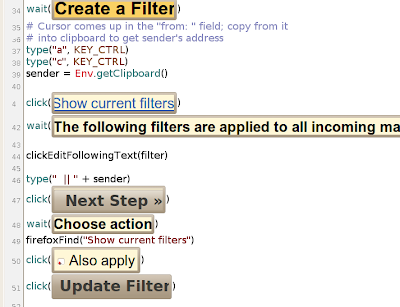
View the Sikuli code, or download it and run it with /path/to/your/sikuli-ide.sh spammy.skl - except you'll probably want to edit the keywords identifying your filter, and possibly recreate the graphics to match your own Firefox theme. Mostly, it's there as an example to learn from.
I'm learning plenty that will go into my Ohio LinuxFest talk, but the big lesson for today is to rely on keyboard-based and text-based techniques rather than picture-finding whenever they're available. For instance, how should I click a button that might have scrolled off the bottom of the screen? There are lots of ways - I could embed find() in a loop with type(Key.PAGE_DOWN), for example - but it's more reliable to piggyback off Firefox's "Find" to zoom in on the text on (or near) the button and then find it.
I'm sure this could be done in Greasemonkey, Selenium, etc., but Sikuli is my tool of interest for the moment - and, after some fumbling, I'm really happy with it.
A partial screenshot, just to give you the idea:

View the Sikuli code, or download it and run it with /path/to/your/sikuli-ide.sh spammy.skl - except you'll probably want to edit the keywords identifying your filter, and possibly recreate the graphics to match your own Firefox theme. Mostly, it's there as an example to learn from.
I'm learning plenty that will go into my Ohio LinuxFest talk, but the big lesson for today is to rely on keyboard-based and text-based techniques rather than picture-finding whenever they're available. For instance, how should I click a button that might have scrolled off the bottom of the screen? There are lots of ways - I could embed find() in a loop with type(Key.PAGE_DOWN), for example - but it's more reliable to piggyback off Firefox's "Find" to zoom in on the text on (or near) the button and then find it.
Wednesday, August 11, 2010
Sikuli at Ohio LinuxFest
And now, for my next trick, one month from today, I shall demonstrate how to script virtually any program with a GUI... without touching an API! (audience gasps)
I'll be spending most of this month using Sikuli to build a test suite for a complex GUI app at work, recording the pain points as I go. I'd also appreciate your questions and comments about Sikuli - I may be able to work them into my talk (or at least be prepared when they're asked from the audience.)
Ohio Linux Fest, Sep. 10 - 12.
If You Can See It, You Can Automate It: Sikuli
Your computer should save you from doing tedious and repetitive tasks yourself, but automation programming has been too difficult for casual uses. MIT's Project Sikuli changes that. It fuses traditional text-base scripts with actual screenshots of targets on your screen, making programming simple, versatile, and useful. If you've ever told a friend, "Go here, now click on this, then on that", you know enough to start using Sikuli. Let Project Sikuli shake up your notions of what programming is like.
I'll be spending most of this month using Sikuli to build a test suite for a complex GUI app at work, recording the pain points as I go. I'd also appreciate your questions and comments about Sikuli - I may be able to work them into my talk (or at least be prepared when they're asked from the audience.)
Ohio Linux Fest, Sep. 10 - 12.
Sunday, August 08, 2010
"Many Eyeballs" - HA!
Oh, yes, I feel I should record this little incident from PyOhio 2010, for the sake of evidence during Nick's trial.
I used PyOhio's Lightning Talks to give away our swag prizes; and, in the spirit of open-source, I put the code on the projector for everyone to see.
Then I realized that I didn't have the Lightning Talk sign-up board, so I went out into the hall to get it. I was gone maybe 60 seconds. When I got back, I called
The room giggled. Nick said, "Wow, that's the first time I've written bug-free code on the first try!" I didn't get it, so he said, "Why don't you pick another winner?"
Nick Bastin!
The nice thing is, my code was intact. However, this was lurking in my directory.
The lesson here is: Many eyeballs can help protect you from malicious code... unless they're all in on it!
I used PyOhio's Lightning Talks to give away our swag prizes; and, in the spirit of open-source, I put the code on the projector for everyone to see.
import csv
import random

regfile = open('registrations.csv')
reader = csv.DictReader(regfile)
registrants = list(reader)

def pick():
    winner = random.choice(registrants)
    return '%s %s' % (winner['First Name'],
                      winner['Last Name'])
Then I realized that I didn't have the Lightning Talk sign-up board, so I went out into the hall to get it. I was gone maybe 60 seconds. When I got back, I called
pick() and got... Nick Bastin!The room giggled. Nick said, "Wow, that's the first time I've written bug-free code on the first try!" I didn't get it, so he said, "Why don't you pick another winner?"
Nick Bastin!
The nice thing is, my code was intact. However, this was lurking in my directory.
$ cat random.py
def choice(foo):
 return {"First Name" : "Nick", "Last Name" : "Bastin"}
The lesson here is: Many eyeballs can help protect you from malicious code... unless they're all in on it!
PyOhio 2010 review
My own PyOhio 2010 wrap-up post is highly suspect, because I'm probably not one to deliver an unbiased opinion. So, when I say that
IT WAS AWESOME
you can be forgiven for being a little skeptical. In fact, one of my few regrets is that I didn't collect firm, objective data on just how awesome it was. I don't have accurate numbers on attendance yet - our sign in sheets are, um, somewhere around here. We had 179 pre-registrations; subtract some no-shows, add some walk-ins, and you get... I don't know. But the place was bustling!
The talks were good, and more importantly, they stimulated some excellent informal activity. The Open Space activity was stronger than ever this year; some of them packed our Open Space rooms to the walls. There were a fair number of Python newcomers there - yay! - and I was glad that we had a good Beginners' Track for them. An After-Hours Board helped people coordinate some evening fun together. Overall, it was not at all just "a place to see talks", but a full immersion in the awesomeness of Python people. Of course, the sprints were the big after-hours event, but they deserve their own post (soon to follow).
OSU's new Ohio Union was a great locale. It helps a lot that it has a design and a staff specialized in holding meetings and conferences, and it's just fantastic that the OSU Open Source club was able to provide the space at incredibly good rates. We look forward to using virtually the same space next year, with just some minor tweaks.
And, for everybody who wondered how we put on a great show at no charge... thank our sponsors!
Here are a couple other wrap-up posts I've happened across. Let me know about others you find.
Alex Gaynor
William Chambers
Richard Harding
IT WAS AWESOME
you can be forgiven for being a little skeptical. In fact, one of my few regrets is that I didn't collect firm, objective data on just how awesome it was. I don't have accurate numbers on attendance yet - our sign in sheets are, um, somewhere around here. We had 179 pre-registrations; subtract some no-shows, add some walk-ins, and you get... I don't know. But the place was bustling!
The talks were good, and more importantly, they stimulated some excellent informal activity. The Open Space activity was stronger than ever this year; some of them packed our Open Space rooms to the walls. There were a fair number of Python newcomers there - yay! - and I was glad that we had a good Beginners' Track for them. An After-Hours Board helped people coordinate some evening fun together. Overall, it was not at all just "a place to see talks", but a full immersion in the awesomeness of Python people. Of course, the sprints were the big after-hours event, but they deserve their own post (soon to follow).
OSU's new Ohio Union was a great locale. It helps a lot that it has a design and a staff specialized in holding meetings and conferences, and it's just fantastic that the OSU Open Source club was able to provide the space at incredibly good rates. We look forward to using virtually the same space next year, with just some minor tweaks.
And, for everybody who wondered how we put on a great show at no charge... thank our sponsors!
- Microsoft
- Intellovations
- AGInteractive
- Dayton Microcomputer Association
Here are a couple other wrap-up posts I've happened across. Let me know about others you find.
Alex Gaynor
William Chambers
Richard Harding
Wednesday, July 28, 2010
PyOhio: photos plz
We have 138 PyOhio registrants so far - that's greater than the total number of attendees last year. I'm excited!
Is there a shutterbug in the house? I'm always envious of the photos taken at some conferences, like this one of Python core sprinters at EuroPython. (Hi, guys! Our contribu-palooza-ers will be joining you soon!) I want to join the fun. Our PyOhio attendees are just as pretty as any of them!
So if you enjoy taking pictures, and you're coming to PyOhio (and who wouldn't?), please don't forget your camera! Get some group shots, and let me know about them afterward. Thanks!
See you Saturday!
Is there a shutterbug in the house? I'm always envious of the photos taken at some conferences, like this one of Python core sprinters at EuroPython. (Hi, guys! Our contribu-palooza-ers will be joining you soon!) I want to join the fun. Our PyOhio attendees are just as pretty as any of them!
So if you enjoy taking pictures, and you're coming to PyOhio (and who wouldn't?), please don't forget your camera! Get some group shots, and let me know about them afterward. Thanks!
See you Saturday!
Subscribe to:
Posts (Atom)