Showing posts with label pycon. Show all posts

Thursday, August 29, 2013

I'm not available

I'm happy to say that I'll shortly be starting a new position as a PostgreSQL DBA and Python developer for Zoro Tools!

We software types seem to have hardware envy sometimes. We have "builds" and "engines" and "forges" and "factory functions". But as it turns out, the "Tools" in "Zoro Tools" isn't a metaphor for cleverly arranged bytes. That's right - they're talking about the physical objects in your garage! Imagine! Lucky for me the interviewers didn't ask to review my junior high shop project.

So disregard my earlier post about being available. Thanks for all your well-wishes!

Depending on how you reckon it, my job search arguably only took forty minutes, though it took a while for gears to grind and finalize everything. Years of building relationships at PyCon made this the best job search ever; the only unpleasant part was having to choose from among the opportunities to work with my favorite technologies and people. I'm very glad I made the investment in PyCon over the years... and if you're thinking "that's easy for you to say, I can't afford it", don't forget PyCon's financial aid program.

And speaking of conferences, I'll be at Postgres Open next month (my first one!) - hope to see some of you there!

Friday, March 29, 2013

released: %sql magic for IPython

Inspired and informed by discussions with the IPython developers at PyCon 2013, I've released ipython-sql, a %sql magic for IPython.

With this, I really think the IPython Notebook will become the most amazing database tool ever. In fact, virtually every computing problem will become a lot more workable when manipulated via the IPython Notebook - you can remember, inspect, and annotate all the steps to investigate whatever your issue is. All hail the Notebook! The FSF really chose well in choosing Fernando Perez for their 2012 award.

Friday, March 22, 2013

The Canadian menace

Incidentally, some people have been asking, "Wait a minute - PyCon-US in Canada? How does that work? Wouldn't it be more correct to call it PyCon-NA for North America?"

It might, if this were a case of nations cooperating to share PyCon. However, that is not the case. You will notice that the Canadians haven't cancelled their own PyCon. Rather, they have seized PyCon-US by ruthless volunteerism and are even now dragging it off to their stronghold on the St. Lawrence, to hoard it along with the PyCon they already have. That's right, they want ALL THE PYCONS.

Pythonistas of the world, be warned! When friendly faces from the North arrive to lend a hand, watch them carefully! Or you'll soon be flying to Vancouver for PyAr and Winnipeg for EuroPython.

Just to clarify: I am giddy over having PyCon in Montreal. I'm so excited that they'll probably need to name a Montreal Syndrome to go along with Jerusalem Syndrome and Paris Syndrome.

post-PyCon post

You might be sick of me saying after each PyCon, "That was the best PyCon ever!", but it's not my fault if it's true.

I hardly know where to start summing up the highlights...

  • PyPGDay was a great addition! I've had virtually no exposure to the PostgreSQL community before, so this was very valuable to me. Evan Klitzke from Uber gave a talk on migrating to PG from MySQL that is going to save me a ton of time, and Jeff Davis from Aster showed off the huge usefulness of range types.
  • Naomi had to talk me into the Education Summit, but I'm glad she did - I got a lot of great ideas and inspiration that will help in teaching future workshops.
  • One of these ideas was the use of Matt Davis' fantastic ipythonblocks, which will let us do graphical exercises right within the IPython Notebook - an amazing, intuitive, seamless learning experience.
  • Speaking of the IPython Notebook, this PyCon was really its tour de force. Seemed like everyone was using it to do and show just amazing things. If you haven't seen some talks on it yet, go watch a bunch of videos immediately and then watch a bunch more when the PyCon 2013 talks are online - the docs alone can't do justice to the possibilities the Notebook creates. We've only begun to take advantage of this fantastic environment.
  • I mentioned my ambition to create an IPython-based SQL client to Fernando Perez from the IPython team, and he jumped to show me what I need to know. The day after coming home, I checked in a %%sql magic. It's not ready for prime time yet (or even PyPi) and it may warrant merging into a similar project, but it was a delight to play off the capability of the Notebook.
  • Peter Wang and Travis Oliphant showed me - personally! - Wakari, an amazingly powerful online hosted Python environment. I can't wait to play.
  • I'm not going to list all the people I loved seeing and catching up with, because it wouldn't mean much to most blog readers. But the fact is it would be a lonely year if I couldn't see my PyCon friends (and make some new ones).
  • If GitHub had an AI, it would be looking at me funny and asking, "What's got into you lately?" PyCon, that's what. And I'm nowhere near done.

Thank you to the fantastic bunch of volunteers who make this such an amazing conference, and to all the participants who bring their ideas and their friendship.

Saturday, March 16, 2013

HTSQL lightning talk slides

I posted the slideshow from my PyPGDay HTSQL lightning talk here. Thanks to everybody involved with PyPGDay, I loved it!

Monday, March 12, 2012

PyCon 2012

Best. PyCon. Ever.

And since PyCon is like my Christmas (in the 5-year-old sense: "I get new toys to play with!"), that's extremely high praise.

This isn't a proper retrospective - don't know if I'll have time to write one - but I just wanted to give thanks and glory to Jesse Noller, the entire volunteer staff (from whom I was notably absent), the proud ranks of the sponsors, and the awesome participants (the word is definitely "participant", not "attendee"). If you were wondering if PyCon's magic could scale, be reassured: the rainbows only proliferate.

PyOhio CFP should be out within a couple weeks, too.

Tuesday, February 14, 2012

Growth in PyCon sponsorship

When I teach Python, I usually include a slide or two about Python's importance and growth. At this point, that's begun to feel unnecessary - but I think I will include this illustration, because it's a neat one.

In 2004, I'd just started looking at Python. When I found out that PyCon would be just a few miles from my sister-in-law's house, I thought, "Why not?" - and I fell in love with the Python community forever. PyCon 2004 had nine sponsors.


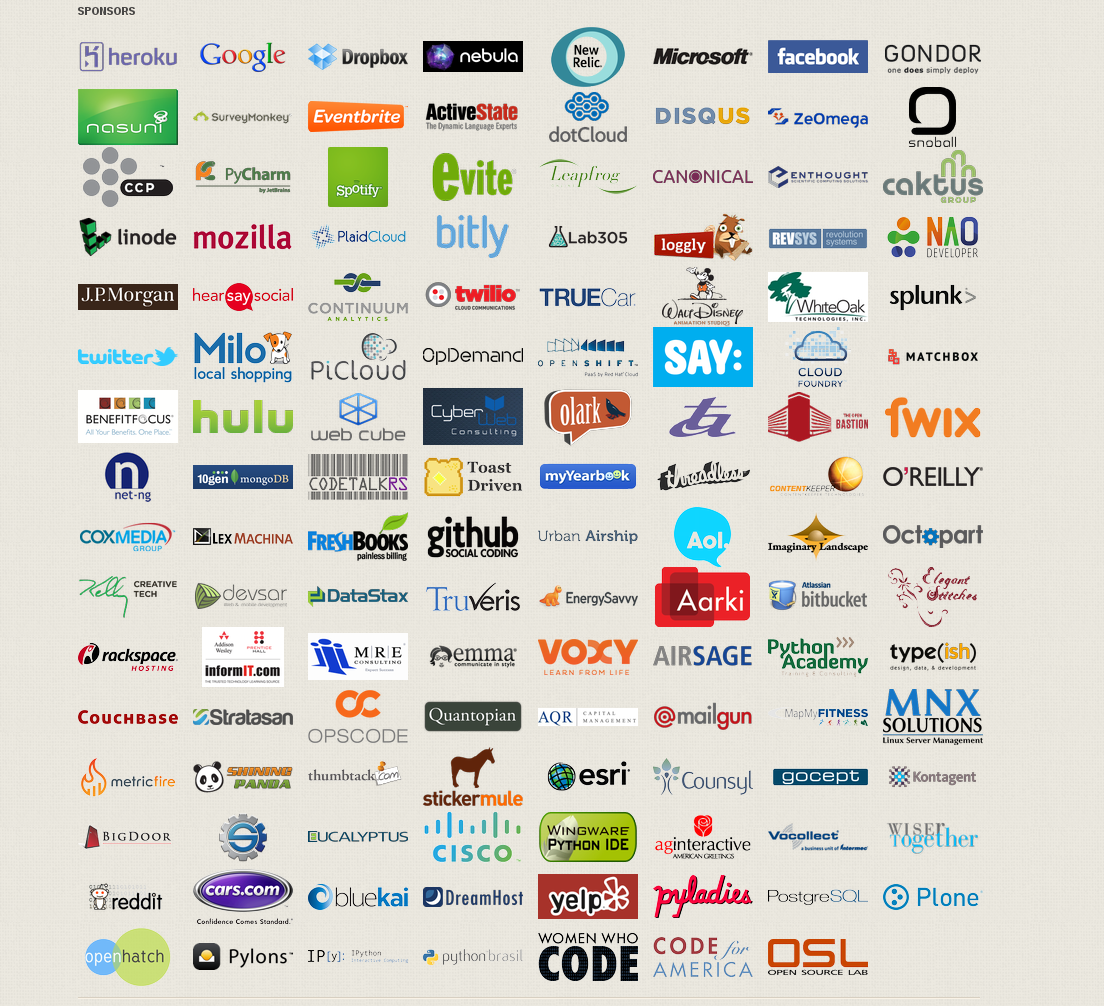
This year, I barely squeaked my registration in before the blast doors slammed shut. Here are PyCon US 2012's sponsors.

Tuesday, November 03, 2009

A PyCon program committee volunteer reflects

The PyCon program committee has finished its work. All submissions have been reviewed, debated, argued on, and voted - often through several cycles. Emails accepting and declining talks have gone out.

I wanted to blog about my impressions as a program committee volunteer. Note that this is totally unofficial, and I'm not speaking on behalf of the committee, PyCon, etc.

It was wonderful

Just reviewing the talks was a great experience. Some of the talks were fun just to visualize; watching them will be even better. I learned lots about what is going on in the Python community. The program committee is a smart and fun crowd to work with, too.

It was horrible

The problem with a programming language that can do pretty much anything is that three days of scheduled talks are nowhere near enough to see everything that's going on. I wish we could have five days of talks, but there are too many people who wouldn't have the time or money for such a conference.

With room to accept fewer than half of our submissions, we had to turn away talks that would have been great. For instance, the one talk I most wanted to see - the proposal I would have walked barefoot to Atlanta for - got declined. What can you do? Often "pretty much everybody was pretty excited about this" talks had to be sacrificed for the sake of "virtually everybody was dying to see this" talks.

But wait, there's more

Fortunately, scheduled talks are only the tip of the PyCon iceberg. We have Lightning Talks, Open Spaces, and (new this year) poster board sessions! I hope all declined speakers will consider taking their material to one or more of those formats!

PyCon is going to be wonderful

I think we have the best crop of presentations we've ever had. If you can look through the list of accepted talks and not start making Atlanta travel plans, then you are already dead.

PyCon is going to be horrible

... because, with five simultaneous tracks packed with the very best of material, I promise you will face multiple can't-miss talks going on at the same time, all day, every day. The painful decisions of the program committee are really only a preview of the difficult decisions every attendee will have to make at the conference itself.

For 2011: increasing your chances

If you want to make your future PyCon proposal more appealing to the committee (making our decisions even harder - thanks a lot), here are some of the things I saw that helped talks make the cut.
  • The basics: a clear talk description, orderly-looking outline, plausible-looking timings. If reviewers ask questions, answer them. Give every impression that you're prepared to put serious effort into your talk.

  • Broad appeal. It's OK to present on specialty topics, of course, but if you can point out ways that even people outside the specialty will also want to see it, it will help.

  • Unusual topic. Every year, there are some hot topics that everybody in the community seems to be talking about... and submitting talks on. Since we're not going to accept a dozen talks on any topic, no matter how hot, these talks need to prevail over a lot of competitors. On the other hand, if you've got a topic that makes the committee say, "HUH? Wow, I'd never heard of anything like that!", it really helps you stand out.

  • We always get more intermediate-level submissions than for beginner or advanced, so the competition was fiercest there.

  • What will attendees get from your talk that they couldn't get simply from reading the docs? Make sure we can tell.

  • Evidence of preparation and skill. Some speakers had established reputations as skillful, engaging presenters; some provided links to their slide decks from earlier versions of their talks given at local groups or regional conferences; a few linked to actual recordings of earlier versions of their talks. Give your talk at a nearby usergroup, then convince one of your group members to volunteer for the program committee. :)

  • Scratch the itch. When committee members say, "Ah, yes, I've been puzzled by that and dying for a proper explanation!" - or, "I personally understand it, but I see misunderstanding of it throughout the community and wish somebody would help clear it up", that is a big plus.

  • Keep the Py in PyCon. If the topic is one of general IT interest - database technology or rich web client programming, for instance - then make sure to emphasize the Python angle of your talk. How do you work the problem from Python specifically? What do Python users need to know about the problem that they won't learn from materials aimed at the IT community overall?
Anyway, my personal thanks to everyone who submitted, and I really hope to see you all at PyCon!