What else is out there?
Tuesday, July 28, 2009
Database comics
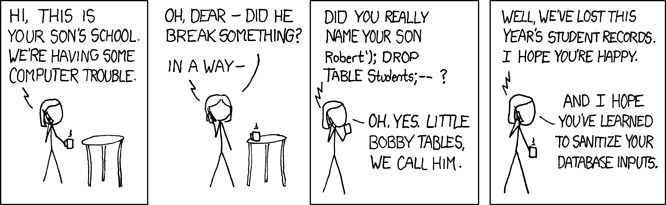
Clearly, it's somebody's responsibility to create a Hall of Fame for database-related comic strips. I may as well start gethering them here.


What else is out there?
Sunday, July 26, 2009
now that's agile
My favorite anecdote from PyOhio 2009:
William McVey prepared slides for his Sunday PyOhio presentation using reStructuredText and rst2s5, but he wasn't satisfied with S5's presentation quality. He tried rst2odp to generate an OpenOffice Impress document instead, but it failed him.
So he convened a Saturday night sprint on rst2odp at PyOhio. Working past midnight, a small team fixed the rst2odp flaws. William regenerated his slides and presented successfully on Sunday.
Finally, in a mighty feat of recursion, he described the feat in a lightning talk Sunday evening, using slides generated by rst2odp, including a slide that contained the source code of the lightning talk he was giving, including the slide with the source code...
Oracle - Linux - Python tutorial slides (PyOhio)
Todd Trichler from OTN is beginning his half of our presentation while I post... my half's materials are here.
Thursday, July 23, 2009
doubleplus PyOhio
>>> 2009 > (2 * 2008)
True
PyOhio 2008 had 93 registrants. PyOhio 2009 has more than doubled that number already. Hooray!
Thursday, July 02, 2009
PyOhio registration, schedule, sponsors...
Things are really coming together!

- PyOhio registration is open. 38 people have signed up in just over a day!
- The talk schedule is up. 25 talks, my goodness.
- Oracle Technology Network and Intellovations have stepped forward as sponsors.
- Oracle is also sending Todd Trichler to cooperate with me on a two-hour tutorial on Oracle/Python/Linux. I'm enjoying the preparations so far - I think you'll like it if you have any interest in databases.
Wednesday, June 24, 2009
don't need no stinking rules engine
There's a whole class of programs called "rules engines". The idea is to remove the details of a process from the hard-code of the program, store them externally, and view/modify them easily. The engine then converts the rules, stored in some sort of custom format, back into an executable form at runtime.
In my experience, Python is an effective rule engine. Thanks to Python's readability, you can store business rules as snippets of Python code - in textfiles, a database table, or wherever you prefer - and business users should be able to read them comfortably. After that, a very lightweight Python program can load the rules and the relevant data and use exec() or eval() to apply the rules to it.
One of my main projects is an example of this. It's program that synchronizes data between two Oracle databases. That sounds easy, but business details complicate it enormously:
My first take on the problem was a large hard-coded PL/SQL procedure. What a nightmare!
Later, I rewrote the rules as snippets of Python. Each rule is stored a database table along with the dates it takes effect and expires, the person authorizing the rule, and a justification. This readable, self-documenting set of rules can also answer questions like, "Why did things change since last month?".
Unfortunately, I didn't know much about object-relational mappers when I wrote it, so the program has clunky data-fetching code. I'm currently working on a third version of the program that uses SQLAlchemy; the resulting program is very short. Broadly, here's what it does:
- Queries the row-level and column-level rules from their respective tables
- Fetches a row from the local database (ours) and the corresponding row from the remote database (theirs)
- The heart of the engine:
Actually, the data dict also includes definitions of a few functions that some of the rules invoke. The function names are chosen to be self-explanatory to business users. For example:
I suppose it wouldn't be too hard to put the function definitions themselves in among the rules, then include locals() in with data, as long as execution order is controlled (easily done by putting execution_order columns in the rules tables). It hasn't been necessary for my project.
- Now row_rules has eval()-able entries like::
and column_rules has exec()-able entries like::
- Add some logging and a "test-run" capacity which reports on the changes without actually performing them. (It uses sqlalchemy.orm.attributes.get_history() for this; make sure to set autoflush=False if you use this, or intermediate flushes might clear the history.)
I suppose I could try writing a sample rules-engine implementation in simple, general terms, that people could crib from for their own "rules engine" applications. I wonder if that would be helpful, or if just the general idea is enough guidance.
In my experience, Python is an effective rule engine. Thanks to Python's readability, you can store business rules as snippets of Python code - in textfiles, a database table, or wherever you prefer - and business users should be able to read them comfortably. After that, a very lightweight Python program can load the rules and the relevant data and use exec() or eval() to apply the rules to it.
One of my main projects is an example of this. It's program that synchronizes data between two Oracle databases. That sounds easy, but business details complicate it enormously:
- Table and column naming, structure, and normalization differ
- Only some rows are transferred, according to a complex set of business rules
- Only some columns are transferred. Column values are combined, split, truncated, have functions applied, etc. Again, governed by a jungle of business rules
- The business rules change continually Rules must be documented. Letting documentation get out of synch with implemented rules is very bad.
- Users may demand explanations for each decision made by the program, down to the row and column level
My first take on the problem was a large hard-coded PL/SQL procedure. What a nightmare!
Later, I rewrote the rules as snippets of Python. Each rule is stored a database table along with the dates it takes effect and expires, the person authorizing the rule, and a justification. This readable, self-documenting set of rules can also answer questions like, "Why did things change since last month?".
Unfortunately, I didn't know much about object-relational mappers when I wrote it, so the program has clunky data-fetching code. I'm currently working on a third version of the program that uses SQLAlchemy; the resulting program is very short. Broadly, here's what it does:
- Queries the row-level and column-level rules from their respective tables
- Fetches a row from the local database (ours) and the corresponding row from the remote database (theirs)
- The heart of the engine:
data = {'ours': ours, 'theirs': theirs}
for row_rule in row_rules:
if not eval(row_rule, data):
return
for column_rule in column_rules:
exec(column_rule, data)
Actually, the data dict also includes definitions of a few functions that some of the rules invoke. The function names are chosen to be self-explanatory to business users. For example:
def fiscalYear(inDate):
if inDate.month > 9:
result = inDate.year + 1
else:
result = inDate.year
return result
data = {'ours': ours, 'theirs': theirs, 'fiscalYear': fiscalYear}
I suppose it wouldn't be too hard to put the function definitions themselves in among the rules, then include locals() in with data, as long as execution order is controlled (easily done by putting execution_order columns in the rules tables). It hasn't been necessary for my project.
- Now row_rules has eval()-able entries like::
id start end code authorized reason
1 1/1/06 7/1/09 ours.funded == "Y" Bob I said so
and column_rules has exec()-able entries like::
id start end code authorized reason
1 2/2/08 if (ours.value > 1000): Steve to annoy Bob
theirs.value = ours.value
- Add some logging and a "test-run" capacity which reports on the changes without actually performing them. (It uses sqlalchemy.orm.attributes.get_history() for this; make sure to set autoflush=False if you use this, or intermediate flushes might clear the history.)
I suppose I could try writing a sample rules-engine implementation in simple, general terms, that people could crib from for their own "rules engine" applications. I wonder if that would be helpful, or if just the general idea is enough guidance.
Friday, June 19, 2009
Python for Secretaries
As if I need a new ambition, I've got an itch to create and teach a course called "Computer Programming for Secretaries". Since I got into IT via the secretarial pool, I think I'm the perfect one to do it.
To outsiders, programming has this horribly intimidating aura. You've got enterprisey Software Architects trying to sound professional, academic Computer Scientists telling you that you're oversimplifying the problem, fearsome Hacker Gods strutting their skillz. Lots of people want to make sure you know how smart they are, and that nothing could happen without their planet-sized brains.
but programming is not rocket science
If you want to launch satellites into space, you need to invest your life in the field and be part of a large, well-funded institution. Yes, you can have lots of fun with model rocketry, but you're just playing. You're not actually going to get anything into orbit.
programming is more like cooking
My friend James is a professional chef. Everything he makes involves a bunch of French words, ingredients I've never heard of, and turns out eyes-roll-back delicious. I don't have the ambition to invest the time and effort to cook that well... but I can still roast a turkey. That's what programming is like, especially dynamic language programming. With a lot of skill, you can work miracles - but with a little skill, you can work little miracles. You don't need to go in for the whole hog.
That's what I'd like a class to address. There are programming books aimed at kids, but none that I know of aimed at adult business users. There are people who could write themselves small, useful programs, but who will flee in well-justified terror if you start talking about overriding import hooks. There are people spending hours cutting-and-pasting from one file to another because they don't know how to write a six-line script. There are people could replace some of their daily tedium with just a little dose of Python. There is Resolver One, which is a fantastic way to integrate tiny dashes of Python with everyday spreadsheet work, but it's being used by thousands instead of by millions.
So... yeah. What should such a class include? More importantly, once I'm ready to teach such a class, where do I teach it?
Monday, June 15, 2009
how to tell a geek
Given a choice between spending an hour doing a task manually, or spending three hours writing a program to do it automatically... a geek will write the program, every single time. And, if not given the choice, if explicitly ordered to do the job manually, we'll disobey and write the program anyway. I've heard it said that a good geek is lazy, but I think it's more precise to say that a geek dreads boredom above all else. We'll move mountains to accomplish a task, as long as it's interesting.
This is not nearly as crazy as it sounds, because after we've "finished" a task, without fail, the requestor will return and say, "I know I said that would just be a one-time change, but...", or, "Actually, it turns out we don't need A B C D, we need A B Q D C", or whatever. You will reuse that program, no matter what they say; never throw it away!
Tuesday, June 09, 2009
NCR
Pardon, oh Citizens of the World who read this, while I go regional for a moment and speak as a Dayton-area resident on news almost certainly irrelevant to you.
The big news here last week was NCR's decision to leave Dayton. Basically, three reasons have been given:
That leaves shorter plane flights for those who fly to Europe - seems a strange reason to move 1,300 people - and a large amount of cash. Many people think Ohio should have tried to outbid Georgia, but that would have to come at the expense of companies that don't threaten relocation - and it begins to blur the line between "private company" and "state-funded entity", anyway.
Moving itself, of course, gets rid of those employees who choose not to relocate. I predict that most Ohioans who choose not to move with NCR will not be replaced; the company will use the natural contraction in place of one of its periodic downsizings.
Anyway, it's sad for Dayton, since the company had such a history here, but that's pretty much what NCR has been about here for years - history. For decades now, growth for Dayton - as for most cities - hasn't come from big, stable, traditional companies but from small companies, appearing and disappearing quickly as new opportunities appear and change and dry up. It's a less predictable business world, but that's the century we're in. No amount of sighing will prolong the 20th century
The big news here last week was NCR's decision to leave Dayton. Basically, three reasons have been given:
- "the high availability of a skilled work force"
- More direct international flights from Atlanta than from Dayton
- $60 to $80 million in incentives from Georgia
That leaves shorter plane flights for those who fly to Europe - seems a strange reason to move 1,300 people - and a large amount of cash. Many people think Ohio should have tried to outbid Georgia, but that would have to come at the expense of companies that don't threaten relocation - and it begins to blur the line between "private company" and "state-funded entity", anyway.
Moving itself, of course, gets rid of those employees who choose not to relocate. I predict that most Ohioans who choose not to move with NCR will not be replaced; the company will use the natural contraction in place of one of its periodic downsizings.
Anyway, it's sad for Dayton, since the company had such a history here, but that's pretty much what NCR has been about here for years - history. For decades now, growth for Dayton - as for most cities - hasn't come from big, stable, traditional companies but from small companies, appearing and disappearing quickly as new opportunities appear and change and dry up. It's a less predictable business world, but that's the century we're in. No amount of sighing will prolong the 20th century
Friday, June 05, 2009
Python Magazine article
I've got an article in this month's Python Magazine: PyOhio: Planning and Running a Regional Python Miniconference. I try to cover some of the stuff we learned in the course of doing the first PyOhio, for the benefit of people considering staging similar conferences of their own. I feel a little silly impersonating an expert on the topic, since I'm near the beginning of a learning process that never ends - but in the open-source world, it's not being the ultimate guru that's important, it's taking the time to share whatever you can.
Python Magazine is a great publication, by the way - with all the good stuff about Python on the net, you might wonder what's the point of buying a magazine, but their articles are very well-chosen and there's a real advantage to being able to read it away from the computer.
Friday, May 29, 2009
Where did you hear about... ?
I've served as PyCon's volunteer publicity chair the past two years. This year, at my request, the attendee survey had the question, "How did you hear about PyCon?"
Thanks to everybody who took the survey and answered that annoying question. Of course, most answers were along the lines of, "Duh, I've always known about PyCon!"
Basically, the answers helped to confirm that community buzz is what brings most people. (My favorite answer: "Birds.") Problem: not everybody is plugged into the buzz. I know lots of programmers who never read blogs or attend groups, and there are lots more that I don't know because they don't do blogs or groups, or otherwise plug themselves into the community.
What I most need is for everybody who didn't hear about PyCon to answer this question: "Why didn't you hear about PyCon? Where would you have seen a PyCon announcement?" The logistics of doing that survey are tricky, however.
How do you think word spreads among geeks, in this day and age?
Friday, May 22, 2009
Wanted: pictoral Field Guide to Nerds
My grandfather was an amazing man. He seemed to know every living soul in Duluth, Minnesota. He never forgot a face.
I didn't inherit that gene. Remembering faces and names is a huge challenge for me. "Very nice to meet you, Mrs. - wait, have we met before? Oh, Mom! I'm sorry." I can spend fifteen minutes in conversation with someone, and five minutes later be unable to bring their face into my mind. It's frustrating and humiliating. I need technological help.
I'd love a website full of labelled and indexed photos of the inhabitants of geekland, something I could brush up on before a conference, or study afterward to cement the new acquaintances into my memory.
Does something like this exist? Failing that, does anybody have some good ideas for how it could be made? At present, my best idea is for some sort of Flickr mashup.
Friday, May 15, 2009
documentation rant
Everybody knows that open-source software documentation sucks.
It doesn't, however, suck nearly as much as big-company proprietary software documentation, which Steve Holden characterizes as
... and so forth... a beautifully-typeset waste of electrons.
The questions we go to docs for are: Can I nardle a threep via SSH? I tried it, but my threep still isn't nardled. I got an "ERROR: Threep nardling failure" message. What now? If those questions aren't addressed, there's really no point.
These days, I do sometimes see open-source docs that address these questions. Most often, of course, you find answers to these questions in the user community.
Anyway, I suggest that, when users run into trouble, this is the preferable order of responses:
1. Change the program so that it acts as the users expected in the first place.
2. Use program interaction and informative error messages to guide users through problems without having to look outside the program.
3. Put the answer in the documentation - and make it easy to find or it doesn't count! Expecting users to comb painstakingly through 400 pages is not realistic.
4. Respond to individual questions via some sort of support process.
Small-to-medium FOSS projects are the best at responding in this order, probably because the same people - or at least people who know each other - are responsible for writing the program, documenting it, and answering user questions. At Big Software Corp., on the other hand, Support, Documentation, and Development are likely to be completely separate groups. The professionalization of documentation is deadly, because you get reams of nearly identical manuals that are pleasantly laid-out and nicely proofread, but completely unaware of realistic user problems. Support is painfully aware of user problems, but they have no process to tell Documentation and Development, "Hey, users keep getting confused here. Can we change the program and the docs to help them? Please? Because we'd really like to quit getting these questions?" (Perhaps some companies do have processes; I can only speculate, but I do know that I don't see evidence of it.)
Oracle, incidentally, only about halfway sucks in these matters, which is pretty good for a company so large. Their docs generally have some good, non-obvious substance, and sometimes - but, alas, only sometimes - troubleshooting information.
In short, I think you need users' pain to efficiently and accurately become developers' and documenters' pain, so that the causes will get fixed. Small FOSS projects have this kind of pain transfer built-in (when the authors publish their email addresses and invite questions). Everybody else should think about how to make it happen for their product.
It doesn't, however, suck nearly as much as big-company proprietary software documentation, which Steve Holden characterizes as
Threep Nardling
To nardle threeps, select the Threep tab and check the Nardling checkbox.
... and so forth... a beautifully-typeset waste of electrons.
The questions we go to docs for are: Can I nardle a threep via SSH? I tried it, but my threep still isn't nardled. I got an "ERROR: Threep nardling failure" message. What now? If those questions aren't addressed, there's really no point.
These days, I do sometimes see open-source docs that address these questions. Most often, of course, you find answers to these questions in the user community.
Anyway, I suggest that, when users run into trouble, this is the preferable order of responses:
1. Change the program so that it acts as the users expected in the first place.
2. Use program interaction and informative error messages to guide users through problems without having to look outside the program.
3. Put the answer in the documentation - and make it easy to find or it doesn't count! Expecting users to comb painstakingly through 400 pages is not realistic.
4. Respond to individual questions via some sort of support process.
Small-to-medium FOSS projects are the best at responding in this order, probably because the same people - or at least people who know each other - are responsible for writing the program, documenting it, and answering user questions. At Big Software Corp., on the other hand, Support, Documentation, and Development are likely to be completely separate groups. The professionalization of documentation is deadly, because you get reams of nearly identical manuals that are pleasantly laid-out and nicely proofread, but completely unaware of realistic user problems. Support is painfully aware of user problems, but they have no process to tell Documentation and Development, "Hey, users keep getting confused here. Can we change the program and the docs to help them? Please? Because we'd really like to quit getting these questions?" (Perhaps some companies do have processes; I can only speculate, but I do know that I don't see evidence of it.)
Oracle, incidentally, only about halfway sucks in these matters, which is pretty good for a company so large. Their docs generally have some good, non-obvious substance, and sometimes - but, alas, only sometimes - troubleshooting information.
In short, I think you need users' pain to efficiently and accurately become developers' and documenters' pain, so that the causes will get fixed. Small FOSS projects have this kind of pain transfer built-in (when the authors publish their email addresses and invite questions). Everybody else should think about how to make it happen for their product.
Tuesday, May 12, 2009
managing installation requirements by Python version
I always feel guilty using this blog as my LazyWeb, but it works really well, so here we go again...
I'm trying out Oracle Enterprise Linux 5 - basically a clone of RHEL - and trying to get sqlpython installed on it. OEL5 comes with Python 2.4; sqlpython 1.6.5.1 needs Python 2.5. I could take out the 2.5 dependency in sqlpython, but it uses pyparsing. Pyparsing dropped 2.4 compatibility as of 1.5.2.
[EDIT: It turns out that pyparsing 1.5.2 still works on Python 2.4. It emits a scary error message, during easy_install under Python 2.4 -
but it installs successfully nonetheless. Thanks to Paul McGuire to pointing that out. So my job in this case is simply to release a 2.4-compatible sqlpython 1.6.5.2.]
I could change
I'd like to
Obviously, I could just download a newer Python and install it on my machine, but I'm trying to make sqlpython usable for DBAs who don't have that kind of authority, or who fear to muck around with their environment that way.
I wonder what the smart people do in situations like this?
I'm trying out Oracle Enterprise Linux 5 - basically a clone of RHEL - and trying to get sqlpython installed on it. OEL5 comes with Python 2.4; sqlpython 1.6.5.1 needs Python 2.5. I could take out the 2.5 dependency in sqlpython, but it uses pyparsing. Pyparsing dropped 2.4 compatibility as of 1.5.2.
[EDIT: It turns out that pyparsing 1.5.2 still works on Python 2.4. It emits a scary error message, during easy_install under Python 2.4 -
except ParseException as err:
^
SyntaxError: invalid syntax
but it installs successfully nonetheless. Thanks to Paul McGuire to pointing that out. So my job in this case is simply to release a 2.4-compatible sqlpython 1.6.5.2.]
I could change
install_requires=['pyparsing>=1.5.1'] to install_requires=['pyparsing==1.5.1'] in setup.py, but that locks everybody into an obsolete pyparsing whether they need it or not. I'd like to
install_requires=(['pyparsing>=1.5.1'] if python.version >= '2.5' else ['pyparsing==1.5.1']), but that's absolutely imaginary syntax.Obviously, I could just download a newer Python and install it on my machine, but I'm trying to make sqlpython usable for DBAs who don't have that kind of authority, or who fear to muck around with their environment that way.
I wonder what the smart people do in situations like this?
Thursday, April 30, 2009
SpeakerRate
I've created a page at speakerrate.com for myself:
SpeakerRate profile
... and populated it with my two upcoming talks.
If you want to use SpeakerRate to give feedback to a speaker, you don't actually have to wait for them to create their own profile - you can enter it yourself.
I don't know if SpeakerRate will grow into the ultimate connecting-to-speakers webtool, but it might. I do know that they support microformats, which is a big plus in my book.
Hope to see some of you at Penguicon (this weekend) or IOUG Collaborate (next week)!
Wednesday, April 29, 2009
right to complaint
(prompted by discussion of porn use at GoGaRuCo - see here, here)
Quick thought: It's not that the community needs to ensure offensive content never happens, or that the community needs to find a single standard of what is appropriate.
The key is the right to complain safely. When complaints are predictably met with accusations of "overreacting", "political correctness", and "intolerance", the resulting message is: Be like us, be silent, or leave.
If you reject the criticism, then try something like, "I think you're wrong, but I accept your right to complain." Complaint is feedback, it's a legitimate part of a community's communication.
(Let me clarify that I've had mostly really good experiences in the software communities I participate in!)
Thursday, April 23, 2009
the expanding reStructuredTextiverse
It seems I'm always coming across new uses for reStructuredText, the plaintext format that goes everywhere. (Really, more of a "set of plaintext conventions" than a format as such.) I'm beginning to imagine a talk reviewing them all for next Fall's Ohio LinuxFest, or maybe a magazine article.
The places you can go with reStructuredText - am I missing any? (I haven't checked these all for viability)
- HTML, XML, pseudo-XML, LaTeX, and S5 (PowerPoint-like presentations), with the conversion utilities in docutils
- rst2a - reStructuredText 2 Anything - docutils conversion utilities, online
- rst2pdf
- rest2web - webpages with templates, navigation structure, etc.
- rst2man - Unix man pages
- Sphinx - easy, multi-page sites for docs or other static content
- epydoc - Automated API documentation
- nabu - ReStructured Text to RDBMS
- rst2odt - Produce files for OpenOffice Writer.
- wiki pages
- Blog clients
- django-rstify - ReStructuredText in Django templates
- Editor support
- rst2word - this would really be the holy grail, for communicating to the unwashed masses. (We in the know can use rst2odt and convert within OpenOffice, but rst2word would get my boss on board.)
- Fuse more templating engines to rst (perhaps not a good idea, violate the readability principle?)
- ReST lexer for Scintilla - this would allow ReST support in WingIDE, too.
Tuesday, April 21, 2009
chocolate
We interrupt this blog with a special message from our sponsor.
My friend James has a new business, Two Bears Chocolates, handmaking organic chocolates. They are crazy-good... I've never been a food snob, but James's chocolates have spoiled me to the point where even "gourmet" mass-produced chocolates seem waxy and bland by comparison. They're a diet aid! I have to eat these chocolates so that I won't be tempted by lesser chocolates!
Anyway, they're expensive, but worth it, and a good gift (see: Mother's Day)... or a good way to maximize your yummy-per-calorie ratio.
He's particularly gung-ho to do custom orders. Go ahead, ask him to make a gooseberry-chocolate truffle in the shape of the state of Michigan. He'll love you for the challenge.
So, as James says, "If you love someone, send Two Bears chocolates. If not, bummer."
Monday, April 20, 2009
calm down
Yes, yes. Oracle is buying Sun, which owns MySQL and Java. No, this is not the end of MySQL. You're being silly.
Oracle is about as open-source friendly as a huge proprietary software company can be, and has been since before it was cool. Oracle adores Linux, and started pushing it vigorously since about, hm, 2002? Oracle has been Java-crazy since that time, too. Oracle's marketing strategy has long been against lock-in - it wants to plug easily into a thriving open-standards economy, not to enclose and lock a walled garden. It's also been very easygoing about licensing, eager to see casual, non-paying users gaining familiarity with its products, knowing that those are the seeds that later big-money sales will come from. It doesn't try to catch and squeeze little fish, it feeds them fish food and waits for them to grow into whales. In short, you over there, slapping MySQL on your Linux box for your brother's home business? Oracle doesn't want to shut you down. Oracle loves you, has always loved you, and wants your love and trust for when you get big.
In fact, if anything, I'm a little disappointed that Oracle's (superb) marketing power, name recognition, and corporate respect will all benefit MySQL and Java... which is all fine and good, except that I'd rather see that gust of wind behind PostgreSQL and Python. (OTN's PyCon sponsorship warmed my heart, to be sure, but I wish there was a way to make ORACLE + PYTHON stop-the-presses news all around techland.)
Monday, April 13, 2009
#amazonfail
If you haven't heard about #amazonfail, this article will catch you up quickly.
1. It's a good reminder that giving market dominance to one company in a crucial role in steering our culture is probably unwise. Let's not have a market where a single company can relegate books to obscurity, intentionally or not. Patronize a variety of booksellers.
2. A proper apology would look something like, "Mr. Doofus Middle Manager didn't think through what he was doing, and company management failed to supervise it properly. We feel humiliated and commit to new efforts to keep book culture diverse and uncensored." Amazon's lame, mealy-mouthed "glitch" non-apology suggests that it has fallen prey to Big Corporatosis. Unless, of course, Amazon really has discovered a homophobic computer glitch, in which case this is huge news for artificial intelligence researchers.
3. This is not the only case where the label "adult content" has had a strangling effect. Actions taken under the justification of "adult content" should never be blandly accepted, but should be carefully examined for accuracy, necessity, and bias.
[ EDIT: A final complaint: Labelling a bad policy, sloppily implemented and poorly supervised, as a "glitch", is blaming the company's technologists for a mistake of its management. It says that Amazon's management does not trust, understand, or respect its technologists. In a technology company, this is a strong signal of decline.)
Subscribe to:
Posts (Atom)